What migrating to Airflow 3 actually looks like in production
Don't you just love getting paged at 2am on a random Saturday (read: WEEKEND) because critical data and reports weren't ready on time? Yeah, I love my job. You trace it back through many layers of infrastructure:
- A Spark job that timed out/crashed/OOM.
- A staging table that's stale.
- A consumable pipeline that never triggered.
Somewhere in that chain, you lose an hour you didn't have to find the root cause, look into similar incident reports, rerun and debug, and then finally get a fix that can be implemented temporarily till the following morning (oh, and don't forget to write the post-mortem incident report too). You really start questioning every life decision that led you to data engineering at this point (exaggerated as it is part of the job, but it did feel like that sometimes la).
That was the reality of running a 3-layer medallion architecture data lake at my previous employer. Millions of payment transactions daily, hard SLAs, downstream systems that couldn't wait. Every extra layer between ingestion and output was another failure point, and another reason to lose sleep.
 Wow! Airflow for data orchestration! Link to meme
Apache Airflow was the backbone of that orchestration. At its peak, the highest-volume product alone had ~50 active DAGs running on Airflow EKS (We had 500 over DAGs across different environments and products). In late 2025, what started as an architecture cleanup turned into two problems at once: collapsing from 3 layered architecture to 2, and upgrading from Airflow 2 to Airflow 3, a major release we'd been quietly ignoring until we couldn't anymore.
Discovery, POCs, and first pipelines to production were done all under 2 months, with team leads and fellow DEs who caught things I missed and pushed the architecture in directions I hadn't considered. Without them, this would've taken a lot longer and broken a lot more things.
This article is that story. I'm writing it the way I wish someone had written it for me before I started (including the embarrassing parts).
Get your kopi ais ready folks, it's somewhat a long one (or you can just skip to the parts that interest you based on the TOC).
1. Wait...we have to migrate this too??
TLDR - we had an architecture problem too..
The problem: 3-layer data lake. Airflow 2 DAGs for ingestion, Airflow 2 + Spark/EMR for transformation (ETL), another Airflow 2 ETL for the consumable layer. Expensive EMR clusters for jobs Athena could handle in seconds, additive SLA delays across every layer, and three things to version, test, and debug for every pipeline.
So how the f*** are we gonna fix this??
The fix: Collapse raw and staging into one layer and keeping it as a 2-layer data lake. Transformation logic applied at ingestion time. Parquet written directly to S3, schema enforced, registered in Glue. Athena can query it the moment ingestion finishes. Airflow 3 now only manages the consumable layer: Athena queries → Iceberg writes via PyIceberg. No Spark in the critical path and still fits the use case perfectly.
The architecture change made the Airflow migration easier to reason about, but it also doubled the scope. Every breaking change in Airflow 3 had to be solved while simultaneously rethinking which DAGs even needed to exist. The rest of this article is about what the Airflow 3 migration actually required and what I faced during the process.
2. Surely it can't be that difficult to migrate...
 yeah i was kinda wrong about this...
Before getting into the specific breaking changes, it is worth understanding why so many things broke. Because when I first hit these errors, I thought I was doing something wrong. I was not. Airflow 3 is genuinely, intentionally different under the hood in ways that invalidate a lot of patterns that worked perfectly fine in Airflow 2.
The Airflow 2.x EOL situation
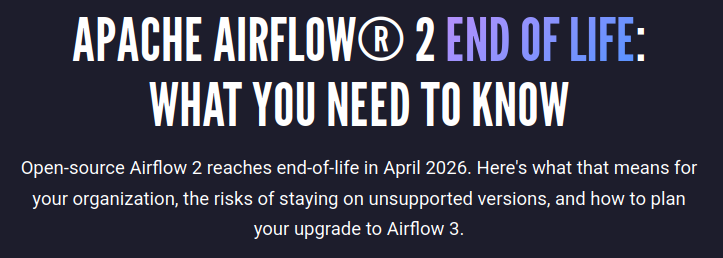 Airflow 2.x EOL announcement — astronomer.io/airflow-2-eol
Open-source Apache Airflow 2.x officially reached end of life on April 22, 2026 (rip). No more security patches, bug fixes, or provider package updates. Your DAGs don't suddenly stop running, but the risk compounds quietly: dependencies drift, provider packages start requiring Airflow 3, and you end up maintaining a frozen environment with no upstream help. "Unpatched CVEs on a data platform storing millions of transaction data" is not a conversation you want to have with your security team, so that added urgency to a migration we were already planning.
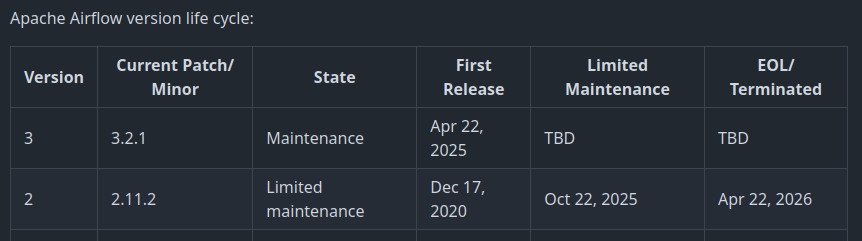 Apache Airflow version lifecycle — github.com/apache/airflow
Airflow 2.x: everything talks to the database directly
In Airflow 2, every component (the scheduler, the webserver, the workers) talked directly to the metadata database. Task code ran in the same process as the worker, with unrestricted access to the DB. No boundaries, no separation.
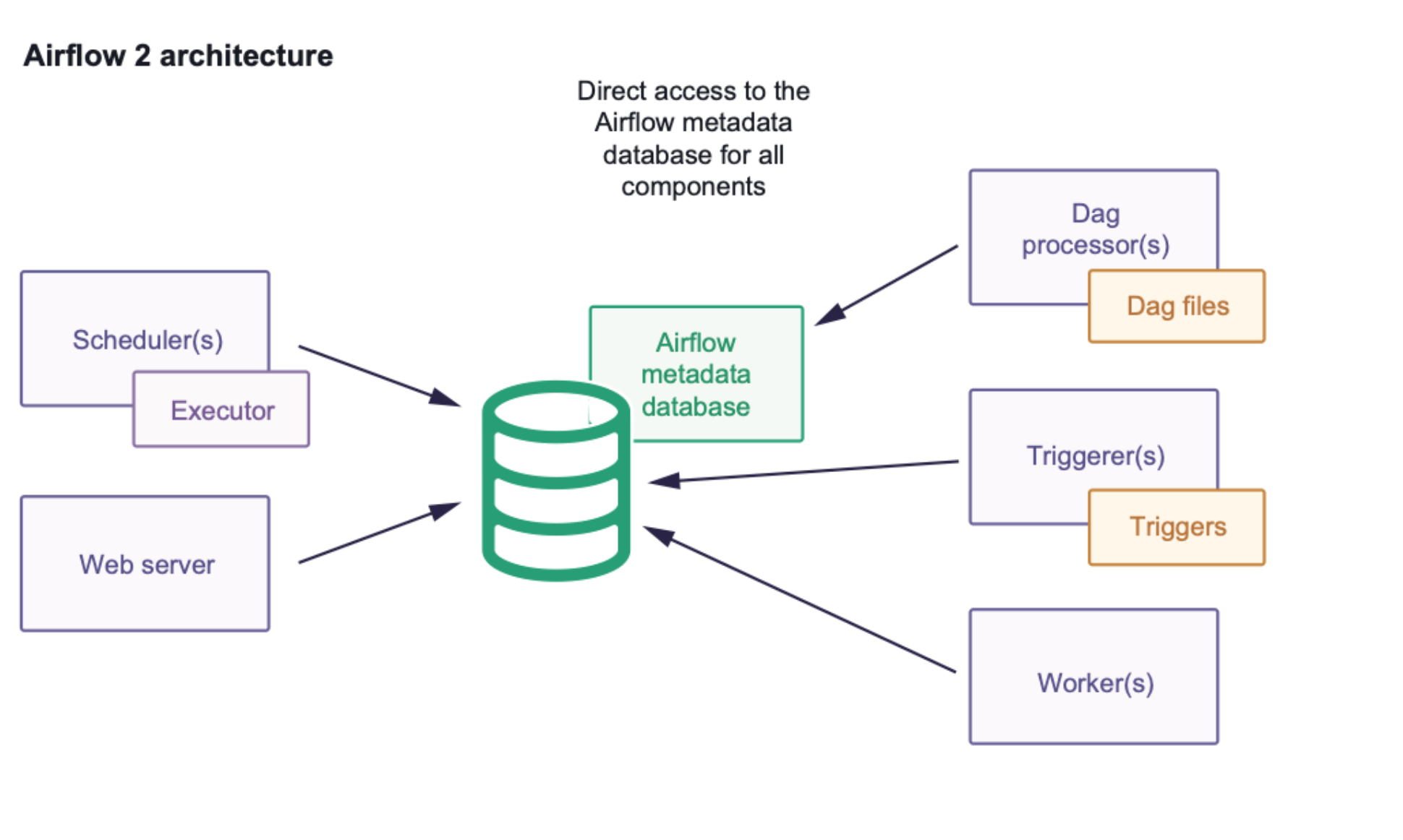 Airflow 2.x: every component connects directly to the metadata database — Upgrading to Airflow 3
Airflow 3.x: a proper client-server model
Airflow 3 introduces the Task Execution Interface which is talked to be the most significant architectural shift in Airflow's history. The core idea is simple but the implications are wide: tasks no longer talk to the database directly. An API Server becomes the single gatekeeper to the metadata database. Workers talk to the API Server. Your task code talks to the Task SDK. Nothing gets direct DB access anymore.
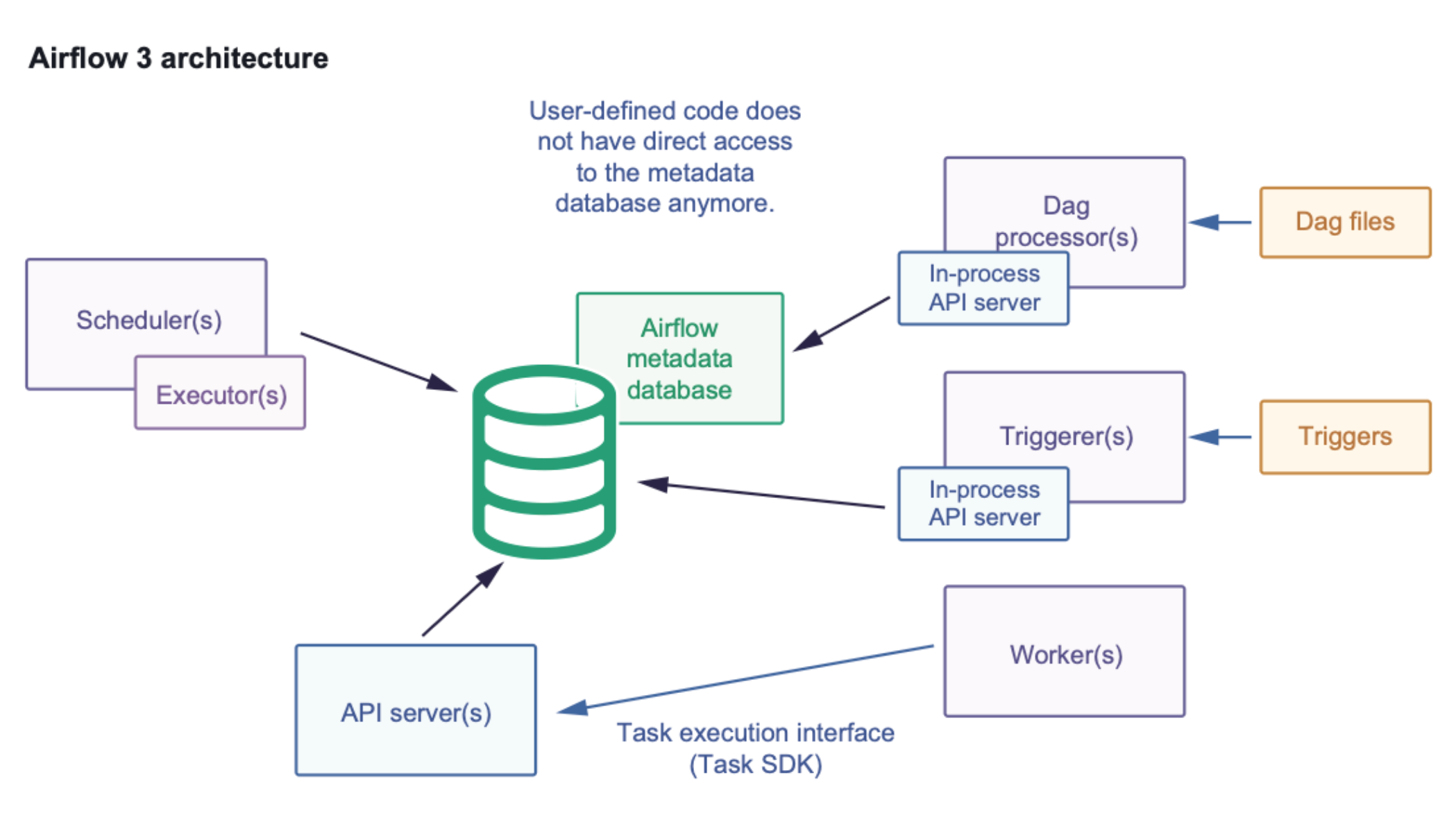 Airflow 3.x: the API Server is the sole gatekeeper — Upgrading to Airflow 3
The practical consequences, which I discovered the hard way:
Task isolation. Task code can no longer import and use Airflow's internal ORM or database sessions. If your DAG or any shared library tries to open a database session at runtime, you will immediately hit RuntimeError: Direct database access via the ORM is not allowed in Airflow 3.0. There is no graceful degradation. It just explodes with a RuntimeError and you spend the next hour figuring out which library buried deep in your shared code is trying to touch the database.
For KubernetesExecutor specifically, the change meant worker pods no longer run persistent worker processes. In Airflow 2, a worker pod would stay alive and handle multiple tasks. In Airflow 3, the KubernetesExecutor injects task execution commands into ephemeral pods that run one task and terminate.
Other things that actually improved
- React UI: fully rewritten, genuinely much nicer than the old Flask AppBuilder interface, and not just cosmetically.
- DAG Versioning: finally. In Airflow 2, deploying a new DAG version mid-run could produce a confused mix of old and new task structure. In Airflow 3, a run executes against the version it started with, all the way through to completion. One less thing to pray about during rolling deployments.
- REST API: moved from
/api/v1(Flask) to/api/v2(FastAPI). Noticeably faster, with proper OpenAPI documentation. - Backfills: now properly scheduler-managed. You can trigger and monitor backfills from the UI or API instead of the CLI, with real-time progress visibility. The scheduler handles execution directly, which means better control and diagnostics when something goes wrong mid-backfill.
3. Airflow 2 vs 3: the code-level changes
Now the part where you find out how many files you need to touch. The answer is: all of them.
Import paths
The new public interface for DAG authoring is airflow.sdk. Everything from airflow.models, airflow.decorators, airflow.utils, and the various internal paths needs to move. Example changes:
| Old (Airflow 2) | New (Airflow 3) |
|---|---|
from airflow.models import DAG |
from airflow.sdk import DAG |
from airflow.decorators import task |
from airflow.sdk import task |
from airflow.decorators import task_group |
from airflow.sdk import task_group |
from airflow.models.variable import Variable |
from airflow.sdk import Variable |
Operators that were previously bundled in airflow-core have also been split into apache-airflow-providers-standard:
# Old
from airflow.operators.dummy import DummyOperator
from airflow.sensors.date_time import DateTimeSensor

# New
from airflow.providers.standard.operators.empty import EmptyOperator
from airflow.providers.standard.sensors.date_time import DateTimeSensor
The good news is you don't have to find all of this manually. The Ruff linter has Airflow-specific rules that catch most of it and can even fix it automatically:
ruff check dags/ --select AIR301 --show-fixes
ruff check dags/ --select AIR301 --fix
Run that first before you do anything else. It won't catch everything but it's a great starting point.
Other deprecations that may or may not bite you:
| Airflow 2 | Airflow 3 |
|---|---|
schedule_interval |
schedule |
concurrency |
max_active_tasks |
provide_context |
(removed — now built in) |
apply_defaults |
(removed — now built in) |
4. Running V2 and V3 in parallel
One question that comes up immediately when you plan a migration like this: how do you run the old pipelines and the new ones at the same time without breaking each other? The answer is not "carefully" but the answer is isolation and running in parallel.
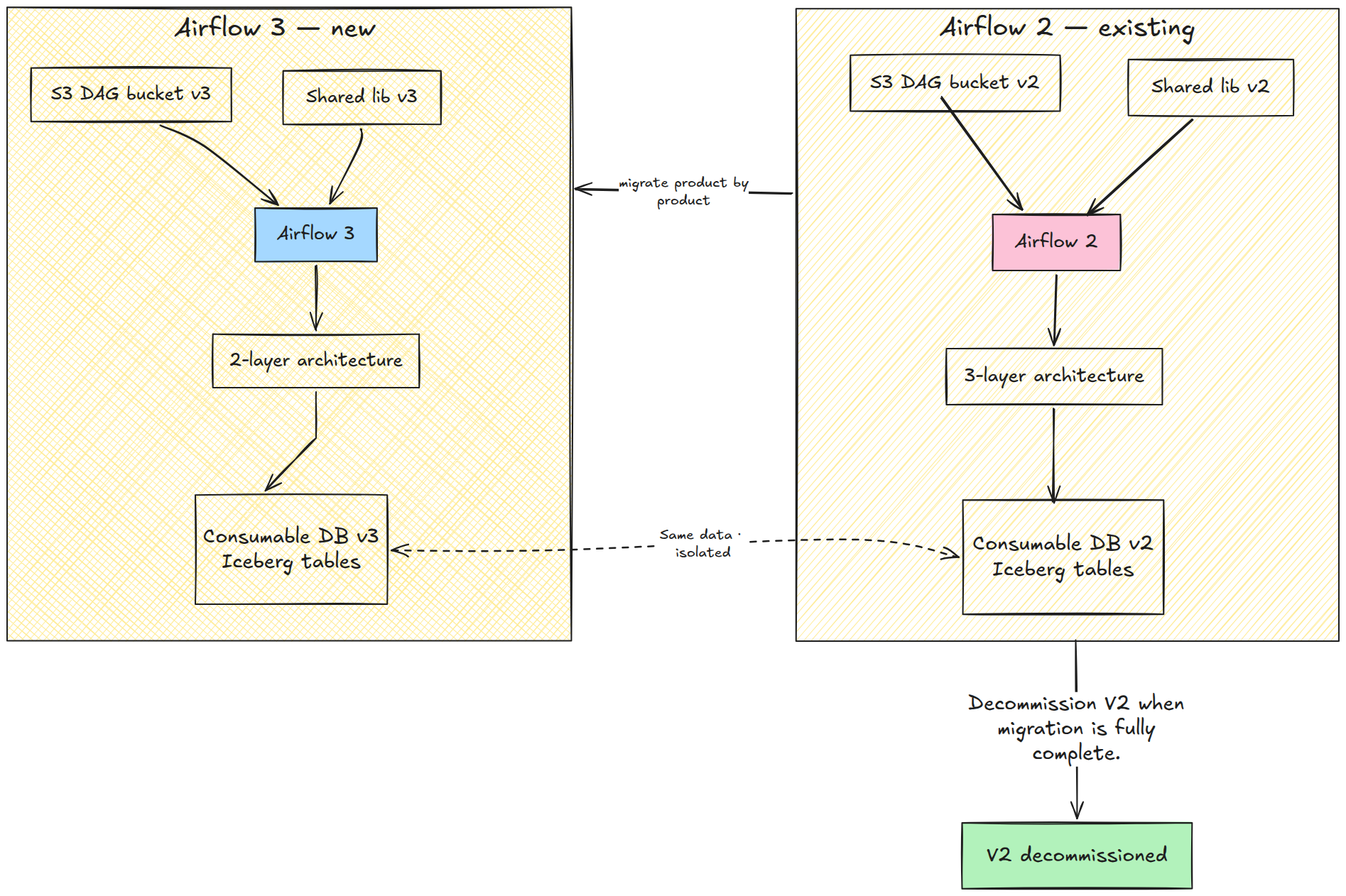 Rough sketch on how Airflow 2 and 3 ran in parallel
We ran two entirely separate Airflow deployments for Airflow 2 and 3. Separate S3 DAG buckets, and separate shared libraries for V2 and V3. The two sets of pipelines had zero shared state. Airflow 2 DAGs kept running against the old 3-layer architecture while Airflow 3 DAGs were built, tested, and promoted product by product using the new 2-layer architecture. If V3 go kaboom and kablow, V2 was completely unaffected.
The provisioning infrastructure was also extended: new Terraform modules pointing to V3-specific paths in the infrastructure repo, new Airflow deployments for the V3 environments, and new V3 dev branches for the engineers to work on and provision. It sounds more complicated than it was but actually in practice it mostly came down to naming things consistently and pointing to the right paths.
This separation meant we could experiment freely without the constant anxiety of "what if this breaks production" and could decommission V2 comfortably once all the DAGs are migrated. That process is still ongoing for some products, but the pattern holds. Double cost for now, but hey that's the price you pay for a steady migration (or not idk).
5. War stories: some of the gotchas I hit during discovery
This is the section I wish had existed before I started. Real errors, real dates, real "wtf why is this happening??" moments from my notes. I'm putting them here so you don't have to rediscover them at midnight.
Note: A note on versions: we ran initial discovery on Airflow 3.0.6, moved active testing to 3.1.5, and are currently (i think) on 3.1.8 in production.
Why do I need to deal with the executor_config??
On my early discoveries with Airflow 3.x, I hit this on the very first real DAG test in our dev environment which I only found in the scheduler logs:
[kubernetes_executor.py:273] ERROR - Invalid executor_config for
TaskInstanceKey(dag_id='redacted',
task_id='define_on_demand_job_arg', ...).
Executor_config: {'KubernetesExecutor': {'request_cpu': '500m',
'limit_cpu': '1000m', 'request_memory': '2Gi', 'limit_memory': '4Gi'}}
The task never started. No helpful error in the DAG logs and the DAG will just get stuck forever. We had executor_config set in default_args which is a completely standard Airflow 2 pattern for specifying CPU and memory limits at the DAG level. Turns out it silently does nothing at the default_args level in Airflow 3. The configuration is accepted, parsed, and then ignored.
What made this particularly hard to diagnose: when executor_config is misconfigured at the DAG level, the scheduler does not throw an error. Instead it quietly falls back to CeleryExecutor for that task. A Celery worker pod spins up instead of a Kubernetes task pod. The task sits in queue indefinitely. You sit there refreshing the Airflow UI wondering if something is broken or if you just need to wait longer.
The tell is in the pod labels. If you see component=worker on the pod but no kubernetes_executor=True label, your task ended up on Celery. That is the first thing to check.
After way too long digging through GitHub issues, the fix was moving executor_config to each individual @task decorator:
# create_eks_ondemand_override is a shared library used with kubernetes.client.models.V1Pod to do pod override
k8s_exec_config = {
    'pod_override': create_eks_ondemand_override(
        annotations={'airflow-data-product': 'my-product'},
        high_priority=True,
    )
}

@task(
    trigger_rule='none_failed_min_one_success',
    executor_config=k8s_exec_config
)
def parse_job_param(**context):
    ...
Also worth noting: the dict-style executor_config is deprecated in Airflow 3. Use kubernetes.client.models.V1Pod with a pod_override key as shown above.
This bug was still present as of Airflow 3.1.8 (our current production version). Before assuming it's been resolved in your version, check the open GitHub issues for KubernetesExecutor but the workaround above applies regardless.
create_or_update_pool and the ORM wall
We used create_or_update_pool in a few DAGs to dynamically manage Airflow pool slots at startup. In Airflow 3, the moment that code runs, you get:
RuntimeError: Direct database access via the ORM is not allowed in Airflow 3.0No partial success, no graceful fallback. The task just dies. This is exactly the Task SDK wall from Section 2 showing up in practice. The fix: use the new REST API (/api/v2) to create and update pools from outside the DAG context or don't use pools at all (which for our case, we removed it entirely).
Scheduling is different now (but why)
This one does not throw an error. Your DAG runs, it succeeds, and you only find out something is wrong when you look at the data. Wait, why is this table empty?
I ran a refactored DAG in dev. Completed successfully. Went to check the output Iceberg table. Empty.
Checked the SQL, lgtm. Ran it manually in Athena, got data. Checked the DAG logs, no errors. Checked the Iceberg table. Definitely empty.
It took embarrassingly long to figure out: both data_interval_start and data_interval_end were pointing to the same timestamp, so WHERE date >= start AND date < end was filtering out literally everything. The window was zero seconds wide.
Here's what actually changed between AF2 and AF3:
| Airflow 2 | Airflow 3 | |
|---|---|---|
| First run | Wait one full interval after start_date |
Starts immediately at start_date |
data_interval_start/end |
Separate, defines a real time window | Collapsed, both equal logical_date |
| Recommended variable | data_interval_start / data_interval_end |
logical_date |
So a @daily DAG starting 2025-01-01 now looks like this:
| Run | Starts at | logical_date covers |
|---|---|---|
| DAG Run 1 | 2025-01-01 00:00 | 2025-01-01 → 2025-01-02 |
| DAG Run 2 | 2025-01-02 00:00 | 2025-01-02 → 2025-01-03 |
# What we had — looks fine, worked in Airflow 2
start = context['data_interval_start']  # e.g. 2025-12-09 00:00
end = context['data_interval_end']      # e.g. 2025-12-10 00:00

query = f"""
    SELECT * FROM raw_db.trxn_tbl
    WHERE date >= '{start.date()}' AND date < '{end.date()}'
"""

# In Airflow 3 without CronDataIntervalTimetable:
# start == end == logical_date → zero-width window → empty result → silent
Given our strict SLA requirements, this could've been an operational nightmare if we hadn't caught it in dev. At least a crash alerts someone because an empty report is not really ideal (well it depends sometimes but you get the gist of it).
The fix: use CronDataIntervalTimetable, which restores Airflow 2 interval behaviour:
from airflow.timetables.interval import CronDataIntervalTimetable

@dag(
    schedule=CronDataIntervalTimetable(
        cron="0 0 * * *",
        timezone="Asia/Kuala_Lumpur"
    ),
    ...
)
def my_dag():
    ...
Or set AIRFLOW__SCHEDULER__CREATE_CRON_DATA_INTERVALS=True in your Airflow env. Either way, put this on your migration checklist and make it non-negotiable. We added it to ours so nobody else had to experience the "why is my table empty" moment.
6. Our shared libraries were f****d too
Yeah, the shared library needed to be rebuilt from scratch as there were too many breaking changes to patch around. I used the chaos to evict dead code that nobody admitted was dead, and reorganize things so a new engineer could actually find stuff. The processor/ layer is the only genuinely new addition: it's the glue between Athena, Polars, and PyIceberg:
shared-library-v3/
└── libraries/
    ├── dag_helper.py              # Kubernetes pod overrides for Airflow v3
    ├── s3_helper.py               # S3 operations
    ├── api_helper.py              # Airflow REST API interactions
    ├── aws.py                     # AWS service clients (S3, DynamoDB, Secrets Manager)
    ├── ssh_helper.py              # SSH/SFTP file transfer
    ├── alert.py                   # Alerting callbacks (on_failure_callback)
    ├── dt_helper/                 # Date/time utilities
    ├── sql_helper/                # Athena query helpers (IRSA-based)
    └── processor/                 # Core ETL processors
        ├── athena_helper.py       # Athena UNLOAD utilities
        ├── loader.py              # IcebergLoader (Polars -> PyArrow -> PyIceberg)
        ├── reader.py              # S3 Parquet reader (Polars)
        └── transformer.py        # Data transformation utilities
The migration surfaced all the accumulated debt in one go. I cleaned it up while I still had the motivation (and sanity). Future engineers will hopefully never know what it looked like before.
The new ETL stack: Polars, PyArrow, and PyIceberg
With Spark off the critical path, we needed a replacement that didn't involve spinning up an EMR cluster to join two tables. The answer: a pure Python pipeline. The flow for every ETL DAG:
pre-ETL setup
    → Athena UNLOAD  (query ingestion layer, write Parquet to S3 temp path)
    → Polars read    (read Parquet from S3 temp — no schema enforcement yet)
    → PyArrow cast   (enforce schema from data_contract.py)
    → PyIceberg write  (load to Glue Iceberg table)
    → end
It's not fancy but it's fast, it works and simple in practice.
7. Trade-offs and what's still unresolved
Of course, not everything was perfect. I had a couple of bumps that I may or may not have solved while I was still employed there...
Data accuracy during merges. The overwrite mode in IcebergLoader does a merge-then-replace of the entire table with deduplication on merge keys. I tested this thoroughly in development, but data loss edge cases during high-volume merges have not been fully characterized at production scale. insert_overwrite is safer for append-heavy patterns. The right mode genuinely depends on each pipeline's semantics, and we are still figuring out the right defaults per use case.
Schema handling. There is an ongoing internal debate about where schema should live: in data_contract.py with explicit PyIceberg types (current approach), or defined entirely in the Athena SQL and enforced through UNLOAD output. Both work. Both have advocates. This will probably evolve as more pipelines migrate and we learn which approach causes fewer headaches in practice.
There are probably more things that I have not discovered that hopefully all my other talented engineers got the bingo moment and reiterate on their own.
8. Reflections
There are probably many takeaways from this migration, but the one I'd most want to pass on to other engineers is to always write and document things as you go.
Originally, I just made internal notes/docs to stop myself from forgetting what I'd broken (I literally wrote down every single detail because I WILL forget something even if I discovered a bug 30 mins prior). I ended up polishing those docs and it somehow became the onboarding material for the entire team to migrate to Airflow 3. Your future teammates will thank you, and so will future-you when you have to explain a decision you made at 2am on a random Wednesday in December (fun times indeed).
None of this came from one person having brilliant ideas in a room. My leaders challenged assumptions and pushed back on early design decisions in ways that made things genuinely better. They created space for me to iterate without pressure to lock things in early. Other DEs migrating their own pipelines found edge cases I'd completely missed and contributed fixes back to the shared library and overall architecture. That back-and-forth is what turned a rough POC into something that actually holds up in production and I'm super grateful for every one of them.
Was it worth it? ~50 DAGs to ~20 (mostly due to the 2-layer architecture). No EMR in the critical path. SLAs that are actually achievable. Transactional data available the moment ingestion finishes. All in all, sounds good to me. Pioneering an architecture design that hopefully makes all the other DEs happier is always a plus as well (unless they refactor everything again but hey that's for another story to tell...).
 Meme creds to this author — Apache Airflow : 10 Rules to Make It Work ( scale )